
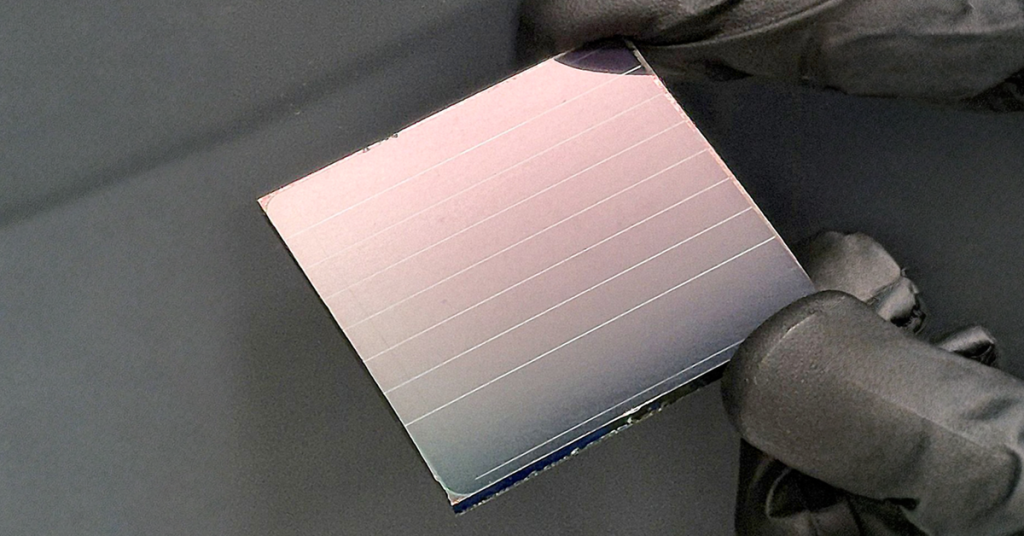
Hi-BITS is one of the thin-film CIGS cell development programs in which Roltec is participating under the Horizon Europe program. One of the program's goals is to design and test new CIGS cell concepts, including bifacial, semi-transparent, and ultra-thin-film (CIGS layer thickness < 1 µm) cells with a mirror integrated into the rear electrode.
In October, the Hi-BITS team began testing the first CIGS modules of this type under real-world operating conditions. This is the first of two test campaigns to be conducted during the project. This will allow for a preliminary evaluation of the proposed material-level innovations in four different locations, from Spain to Sweden. In addition to the electrical parameters of the prototype devices, the test stations also record time, local solar radiation intensity, and temperature. Periodic visual inspections and control measurements are also performed under standard laboratory conditions.
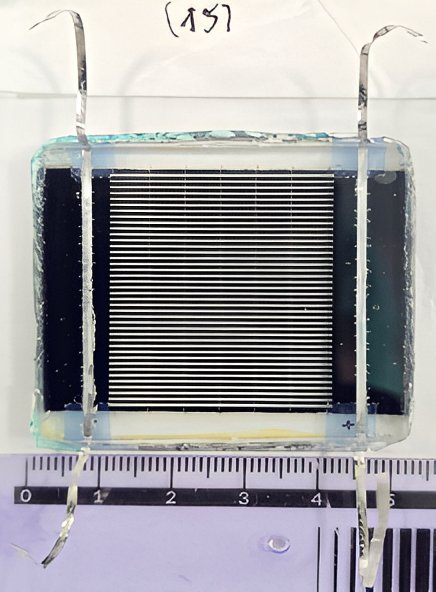
Photo 1. One of the prototype semi-transparent modules after encapsulation.
The first modules will also be tested for proper weather protection, allowing for better preparation for the next campaign, scheduled for the summer and fall of next year. A fourth prototype – a CIGSe/Perovskite tandem module – is to be added to the second campaign. Finally, comprehensive life-cycle analyses, production scalability assessments, and cost evaluations will provide a preliminary answer to whether the technological solutions developed in the project have a chance of meeting market needs. From a potential application perspective, BIPV and agrophotovoltaics are particularly interesting.
Roltec is primarily supporting the production of two of the four prototypes: bifacial and semi-transparent modules. The team recently developed a method for structuring semi-transparent modules that prevents short circuits at the boundaries of active regions. This reduces losses when transitioning from small cells (area <0.5 cm² ) to prototype modules (area up to 10x10 cm² ) .
The Hi-BITS consortium has also released the first scientific publications and parameters needed for computer simulations of individual layers and cells. The repository will be gradually expanded and can be found on the Zenodo platform: https://zenodo.org/communities/hi-bits/records . You can also follow the latest news on the project's main website: https://www.hi-bits.eu/news